Skip to content
What is HIFU?
HIFU — High-Intensity Focused Ultrasound — is a non-surgical treatment that tightens and lifts skin by delivering precise ultrasound energy deep into the structural layers beneath the surface. It triggers your skin’s own collagen production, producing a gradual, natural lift without any incision, injection, or recovery period.
Unlike lasers and radiofrequency devices that work on the skin’s surface, HIFU targets the SMAS layer — the same deep tissue that surgeons address in a traditional facelift. The difference is there’s no surgery involved. No anaesthesia, no stitches, no time off work.
If your skin has started to lose its firmness — around the jawline, under the chin, across the neck, or below the eyes — HIFU is often the first medically sound option worth considering before committing to something more invasive.
15+
Years of Experience
2.5k+
Happy Patients
HOW HIFU WORKS
H2: How Does HIFU Actually Work?
Focused ultrasound energy bypasses the skin’s surface entirely and concentrates at specific depths inside the tissue — typically 1.5mm, 3.0mm, and 4.5mm below the skin. At each depth, it creates tiny thermal injury points. These controlled heat points trigger a wound-healing response, prompting your body to build fresh collagen to repair the area.
The result isn’t immediate — collagen remodelling takes time. Most patients begin noticing a visible difference within 6 to 8 weeks, with the full outcome appearing over 3 to 6 months as collagen continues to rebuild.
The SMAS layer — Superficial Musculoaponeurotic System — is the key. This fibromuscular structure sits roughly 4.5mm below the skin surface and is responsible for supporting facial volume and contour. When it weakens with age, the face starts to sag. HIFU reaches this layer directly, making it uniquely effective among non-invasive treatments.
In short: HIFU doesn’t change your face. It restores the structural foundation underneath it.

What Can HIFU Treat?
HIFU is versatile. It can be applied to the face, neck, and certain body areas depending on what you’re trying to address.
- Loose skin around the jawline and jowls
- Fine lines and skin laxity on the forehead
- Brow drooping that makes eyes appear heavy
- Hollowing or sagging of the cheeks
- Double chin and submental fat
- Neck banding and loose neck skin
- The area along the décolletage
- Inner arms
- Abdomen (mild laxity post-weight loss or post-pregnancy)
- Inner thighs
One session typically addresses one or more treatment zones. Your specialist will map out the areas and number of shots (transducer passes) needed based on your anatomy during the consultation.
HIFU vs Ultherapy vs Thermage — What's the Difference?
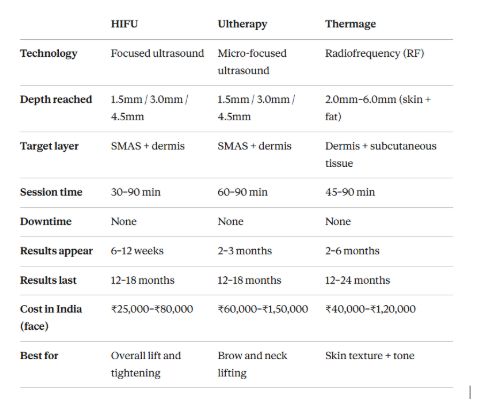
A lot of patients come in having already researched these three. They’re often confused because the marketing language sounds similar. Here’s a straightforward comparison:
The practical difference for most patients: HIFU offers clinically comparable results to Ultherapy at a significantly lower price point, using the same fundamental technology. Thermage uses a different mechanism (RF rather than ultrasound) and works better for patients where texture and tone are the primary concern rather than structural lift.
At Aesthetic DNA, we help you determine which approach — or combination — makes the most clinical sense for your skin.
Are You a Good Candidate for HIFU?
HIFU works best for patients who have early to moderate skin laxity and are looking for a non-surgical option. It is not a replacement for a surgical facelift in patients with significant skin excess, and we will tell you honestly if that’s the case.
You’re likely a strong candidate if:
- You’re between 30 and 65 years old
- You have mild to moderate skin looseness on the face, jaw, or neck
- You want to maintain your results from a previous cosmetic procedure
- You’re not ready for surgery but want something with real, visible results
- You have Fitzpatrick skin types III–V (Indian skin tones respond well to HIFU; there is no melanin disruption risk as with certain lasers)
HIFU may not be suitable if:
- You have an active skin infection, open wounds, or severe cystic acne in the treatment area
- You are pregnant or breastfeeding
- You have a pacemaker or implanted electronic device
- You have metal implants in the treatment area (dental implants in separate zones are generally fine)
- Your degree of skin laxity is beyond what HIFU can address non-surgically
The only way to know for certain is a face-to-face consultation with a proper skin assessment. We do not recommend or confirm HIFU candidacy over phone or WhatsApp.
Your HIFU Treatment at Aesthetic DNA — What Actually Happens
Before your session:
Your first appointment is a consultation, not a treatment. A specialist will assess your skin’s laxity grade, map the areas of concern, and discuss your goals realistically. If HIFU is the right fit, a treatment plan is agreed before anything is booked.
Remove all makeup and skincare before your treatment day. Avoid sun exposure for 48 hours prior.
During the session:
A thin layer of ultrasound gel is applied to the treatment area. The HIFU transducer is moved systematically across the skin in a series of lines, delivering focused energy at programmed depths. You’ll feel warmth, and occasionally a brief, sharp sensation as the energy reaches the SMAS layer — this is the thermal coagulation point being created, and it’s a sign the device is working at the right depth.
Sessions typically last 30 to 60 minutes for a face and neck treatment. There is no anaesthesia required, though a topical numbing cream can be applied if you prefer.
After the session:
You leave the clinic looking like yourself. There may be mild redness or slight swelling in the treatment area, which usually resolves within a few hours. A small number of patients experience temporary tingling or tenderness over the treated zone for a few days.
You can return to work immediately. No sun avoidance protocol, no special diet, no downtime.
Results timeline:
- Weeks 2–6: Skin may feel slightly firmer
- Months 2–3: Visible tightening and lift begins to appear
- Months 4–6: Full result — firmer skin, improved jawline definition, reduced laxity
- Month 12–18: Results begin to fade as natural ageing continues; a maintenance session is recommended
FAQ About HIFU
Is HIFU painful? Most patients describe the sensation as warmth with occasional brief, sharp pulses — particularly when the energy reaches the deeper SMAS layer. The discomfort is generally tolerable without anaesthesia. For patients with lower pain thresholds, a topical numbing cream can be applied 30 minutes before the session begins. The sensation stops immediately when the transducer is lifted.
Yes, HIFU pairs well with several other procedures. PRP (Platelet-Rich Plasma) applied after HIFU can support collagen formation and speed the healing response. Dermal fillers address volume loss that HIFU cannot correct. Thread lifts can be combined for patients who want both structural lift and physical support. Your specialist will discuss which combinations make sense for your goals and your anatomy.
Aesthetic DNA is a cosmetic and plastic surgery centre in Goa offering a full range of surgical and non-surgical treatments. Our non-surgical department — which includes HIFU, PRP, chemical peels, and dermal treatments — operates within the same specialist-led environment as our surgical wing. This matters for HIFU specifically. The precision of the treatment depends heavily on who is holding the transducer, how well they understand facial anatomy, and whether they're working from a clinical assessment or simply running a standard protocol. Our specialists map each patient individually before any session begins. We also don't use entry-level HIFU devices. The machines used in beauty salons and many budget clinics deliver significantly fewer shots at lower intensity than medical-grade systems, which directly affects what you get out of the treatment. If you're considering HIFU in Goa, or travelling to Goa for treatment, we offer in-person consultations as well as pre-visit virtual assessments.
Aesthetic DNA is a cosmetic and plastic surgery centre in Goa offering a full range of surgical and non-surgical treatments. Our non-surgical department — which includes HIFU, PRP, chemical peels, and dermal treatments — operates within the same specialist-led environment as our surgical wing. This matters for HIFU specifically. The precision of the treatment depends heavily on who is holding the transducer, how well they understand facial anatomy, and whether they're working from a clinical assessment or simply running a standard protocol. Our specialists map each patient individually before any session begins. We also don't use entry-level HIFU devices. The machines used in beauty salons and many budget clinics deliver significantly fewer shots at lower intensity than medical-grade systems, which directly affects what you get out of the treatment. If you're considering HIFU in Goa, or travelling to Goa for treatment, we offer in-person consultations as well as pre-visit virtual assessments.